
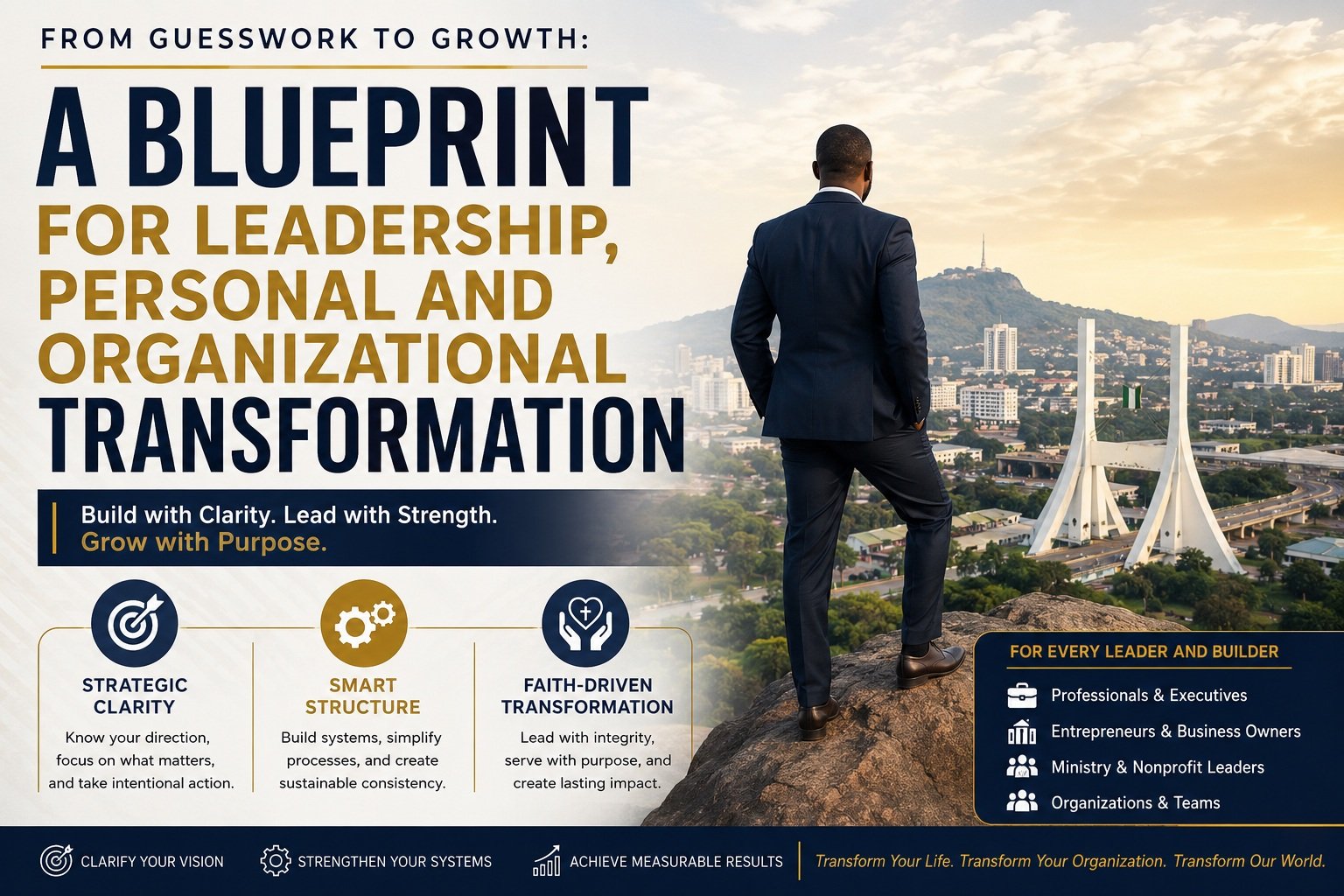
Many people are working hard, but not all hard work is producing the right results.
Across Abuja, Nigeria, and many fast-moving environments, you will find professionals, entrepreneurs, ministry leaders, executives, consultants, and organizational founders who are deeply committed to growth. They attend meetings, respond to demands, manage teams, pursue opportunities, create plans, and carry the emotional weight of leadership. Yet, after months or even years of intense effort, many still feel stuck.
The question is no longer whether people are busy. The real question is whether their busyness is moving them toward measurable transformation.
This is where many individuals and organizations face a painful gap: the gap between intention and execution.
A leader may have vision, but lack structure. A professional may have talent, but lack positioning. A business may have potential, but lack systems. A ministry may have calling, but lack order. An organization may have strategy on paper, but lack the discipline to implement it consistently.
Growth does not happen merely because people desire it. Growth happens when desire is supported by clarity, structure, discipline, values, and measurable action.
This is the heart of transformational leadership and personal development. It is not just about motivation. It is not just about ambition. It is not just about working longer hours. It is about building the inner capacity, strategic systems, and execution rhythm required to turn potential into visible results.
The Problem with Guesswork
One of the greatest enemies of growth is not laziness. It is guesswork.
Many people are not failing because they are unwilling to work. They are failing because they are working without a clear model. They are trying many things, copying many people, following trends, reacting to pressure, and hoping something will eventually work.
Guesswork is expensive. It consumes time, energy, money, relationships, credibility, and confidence.
In personal development, guesswork makes a person chase every new idea without building deep competence in any clear direction. In business, it makes entrepreneurs launch products without understanding their market. In leadership, it makes executives respond to symptoms instead of solving root problems. In ministry and social impact work, it makes passionate people burn out because zeal is not supported by structure.
The problem is not always lack of effort. Often, the problem is lack of clarity.
Clarity tells you what matters most. Structure tells you how to pursue it. Discipline keeps you committed when excitement drops. Accountability helps you measure whether your actions are producing the right results.
Without these four elements, even sincere effort can become scattered.
Why Hard Work Alone Is Not Enough
Hard work is valuable, but hard work alone is not a complete strategy.
There was a time when working harder than everyone else could give a person a strong advantage. Today, the environment has changed. Technology is moving faster. Competition is rising. Clients are more informed. Organizations are under more pressure. Ministries and nonprofits must show credibility and impact. Professionals must differentiate themselves in a crowded market.
In such an environment, effort must be intelligent.
A person can work twelve hours a day and still be moving in circles. An organization can hold several meetings every week and still fail to execute its priorities. A leader can be constantly available and still become the bottleneck preventing growth.
This is why leadership development, personal growth, and organizational transformation must go beyond inspiration. They must become practical, measurable, and system-driven.
The question should not only be, “Am I working hard?”
A better question is, “Is my effort aligned with my highest-value outcomes?”
Another important question is, “Am I building systems that can multiply results beyond my personal effort?”
The Three Growth Barriers Holding Many Leaders Back
There are three major barriers that often prevent individuals and organizations from moving from potential to performance.
1. Operational Drag
Operational drag happens when an individual or organization spends too much energy maintaining activities that do not significantly contribute to growth.
It appears as unnecessary meetings, unclear approval processes, duplicated work, poor communication, outdated routines, and decisions that always return to one person. It can also appear in personal life as overcommitment, poor scheduling, distraction, lack of prioritization, and the inability to say no.
Operational drag creates the illusion of productivity. Everyone appears busy, but the most important things are not moving forward.
For organizations, operational drag weakens performance. For leaders, it creates fatigue. For professionals, it slows career growth. For entrepreneurs, it reduces profitability. For ministries and nonprofits, it limits impact.
The solution is not merely to do more. The solution is to simplify, prioritize, delegate, automate where possible, and build clear operating systems.
Every serious leader must regularly ask: What are we doing that no longer serves our mission? What can be removed, simplified, delegated, or improved? What activity is consuming energy without producing value?
2. The Bottleneck Leader
Many leaders are proud of being needed by everyone. At first, it feels like influence. Over time, it becomes a weakness.
When every decision depends on one person, growth becomes limited by that person’s availability, energy, and attention. The organization cannot move faster than the leader’s personal capacity. The team cannot mature because the leader has not empowered them to think, decide, and execute responsibly.
This is the bottleneck leadership problem.
A bottleneck leader may be gifted, visionary, hardworking, and sincere. Yet, if everything depends on that leader, the system remains fragile.
True leadership is not proven by how much people depend on you. It is proven by how much capacity you build in others.
The best leaders do not merely carry the work. They develop people, design systems, clarify expectations, and create structures that allow others to perform excellently.
Leadership maturity is the movement from control to multiplication.
3. The Values-Action Disconnect
Many individuals and organizations have beautiful values, but their daily actions do not reflect those values.
A company may claim integrity, but reward shortcuts. A school may claim excellence, but tolerate poor standards. A ministry may speak about service, but operate with disorder. A professional may value growth, but never invest in learning. A leader may speak about accountability, but avoid feedback.
This is the values-action disconnect.
Values are not proven by what is written on a wall, website, profile, or proposal. Values are proven by decisions, habits, systems, and consequences.
If excellence is a value, it must show in preparation. If integrity is a value, it must show in financial conduct. If service is a value, it must show in how people are treated. If growth is a value, it must show in learning, evaluation, and improvement.
Transformation begins when values stop being statements and become operating principles.
A Practical Blueprint for Sustainable Growth
Sustainable transformation requires a complete approach. It must address the person, the leader, and the system.
For individuals, growth must be personal before it becomes visible. For leaders, growth must become influence. For organizations, growth must become structure, culture, and performance.
A practical blueprint for sustainable growth can be built around three essential pillars: clarity, structure, and transformation.
Pillar One: Strategic Clarity
Strategic clarity is the ability to know where you are going, why it matters, what must be done, and what must be ignored.
Many people fail not because they have no options, but because they have too many options and no clear filter. They want to do everything, serve everyone, pursue every opportunity, and respond to every invitation. Eventually, their energy becomes divided.
Strategic clarity helps you identify your highest-value direction.
For a professional, this may mean defining the kind of career, expertise, and personal brand you want to build. For an entrepreneur, it may mean knowing the exact customer you serve and the problem you solve. For an organization, it may mean choosing the few priorities that will produce the greatest impact. For a ministry or nonprofit, it may mean aligning activities with mission instead of simply maintaining tradition.
Clarity requires honest questions:
What exactly are we trying to achieve?
Who are we called or positioned to serve?
What problem are we solving?
What result must be visible within the next 90 days?
What must we stop doing because it no longer supports the mission?
Without clarity, people confuse movement with progress. With clarity, effort becomes focused.
Pillar Two: Organizational and Personal Structure
Structure is what makes growth repeatable.
Many people experience short bursts of success but cannot sustain them because there is no structure. They depend on emotion, pressure, urgency, or personal memory. But sustainable growth requires systems.
A business needs structure for sales, operations, finance, customer service, delivery, reporting, and decision-making. A leader needs structure for delegation, meetings, feedback, planning, and accountability. A professional needs structure for learning, visibility, relationship building, and performance improvement. A ministry needs structure for discipleship, administration, communication, follow-up, and leadership development.
Structure does not kill creativity. Good structure protects creativity from chaos.
When there is no structure, everything becomes urgent. When there is structure, people know what to do, when to do it, who is responsible, and how success will be measured.
One of the marks of maturity is the ability to build systems that do not depend entirely on your mood, memory, or presence.
If your growth depends only on how inspired you feel, it will not last. But when your growth is supported by structure, you can keep moving even when conditions are not perfect.
Pillar Three: Faith-Driven Transformation
For those who see leadership as more than a career pursuit, transformation must also be rooted in purpose, character, and stewardship.
Faith-driven transformation recognizes that leadership is not merely about position. It is about service. It is about becoming the kind of person who can be trusted with influence, responsibility, people, resources, and opportunities.
Skills are important, but character sustains influence.
A gifted leader without discipline will eventually become inconsistent. A visionary leader without humility may become difficult to correct. A strategic leader without integrity may create results that cannot be trusted. A hardworking leader without rest may eventually burn out.
Faith-driven transformation asks deeper questions:
Who am I becoming while pursuing success?
Are my methods consistent with my values?
Is my ambition submitted to purpose?
Am I building people or merely using people?
Am I pursuing growth in a way that honors God, serves people, and strengthens society?
This kind of transformation does not separate excellence from spirituality. It brings them together. It recognizes that work can be meaningful, leadership can be service, and success can become a platform for greater impact.
Moving from Operator to Architect
One of the most important shifts every growing leader must make is the shift from operator to architect.
An operator is deeply involved in doing the work. An architect designs the system that makes the work effective.
At the early stage of a career, business, ministry, or organization, being an operator is often necessary. You do many things yourself because resources are limited. But if you remain only an operator, growth will eventually overwhelm you.
The architect thinks differently.
The architect asks: How can this be systemized? Who can be trained to handle this? What process will make this easier next time? What standard should guide this decision? What tool can reduce manual effort? What rhythm will keep everyone aligned?
This shift is critical for leaders in Abuja and across Nigeria, where many people are building under pressure, with limited resources, changing economic realities, and increasing expectations.
You cannot scale confusion. You can only scale clarity.
You cannot multiply disorder. You can only multiply what has been properly structured.
The 90-Day Growth Sprint
Transformation becomes easier when it is broken into focused timeframes. One of the most effective ways to move from intention to execution is through a 90-day growth sprint.
A 90-day sprint is long enough to produce meaningful progress, but short enough to maintain urgency and focus.
Instead of creating large plans that remain untouched, a 90-day sprint forces you to identify what must change now.
For personal growth, a 90-day sprint may focus on building a new skill, improving visibility, strengthening communication, developing a personal brand, or becoming more disciplined.
For a business, it may focus on increasing revenue, improving customer experience, restructuring operations, launching a product, or building a stronger sales system.
For an organization, it may focus on leadership development, staff accountability, strategy implementation, performance measurement, or culture improvement.
For a ministry or nonprofit, it may focus on volunteer structure, outreach effectiveness, discipleship systems, communication, fundraising, or impact reporting.
The power of a 90-day sprint is that it converts vision into action.
At the beginning of the sprint, you define the goal. During the sprint, you track progress. At the end of the sprint, you review results, learn lessons, and set the next focus.
This rhythm creates momentum.
A Simple Framework for Immediate Application
If you want to begin moving from guesswork to growth, start with these five steps.
First, define the outcome. Be specific about what you want to achieve. Do not simply say, “I want to grow.” Say what growth should look like in measurable terms.
Second, identify the constraint. Ask what is currently limiting progress. Is it lack of clarity, poor structure, weak visibility, inconsistent execution, limited funding, poor delegation, or lack of accountability?
Third, simplify the priorities. Choose the few actions that will create the greatest movement. Too many goals create distraction.
Fourth, create a rhythm of execution. Decide what must be done daily, weekly, and monthly. Growth requires rhythm, not occasional enthusiasm.
Fifth, review and adjust. What you do not measure, you cannot improve. Evaluation helps you know what is working, what is failing, and what needs to change.
This framework is simple, but powerful. Many people do not need more noise. They need a clearer path.
Why This Matters Now
The future will not reward only those who are busy. It will reward those who are clear, prepared, disciplined, adaptable, and value-driven.
Nigeria needs professionals who can solve problems, not just carry titles. Abuja needs leaders who can build systems, not just attend meetings. Organizations need executives who can execute strategy, not just discuss it. Ministries and nonprofits need structures that can sustain impact beyond passion. Entrepreneurs need business models that can survive beyond excitement.
This is why personal development, leadership growth, and organizational transformation are no longer optional. They are essential.
The people and institutions that will thrive in the coming years are those willing to stop guessing and start building intentionally.
Conclusion: Build with Clarity, Lead with Strength
The gap between where you are and where you could be is not always a matter of talent. Sometimes, it is a matter of structure. Sometimes, it is a matter of clarity. Sometimes, it is a matter of discipline. Sometimes, it is a matter of leadership transformation.
You do not need to keep moving in circles. You do not need to keep reacting to problems that better systems could prevent. You do not need to carry alone what proper structure can help others share. You do not need to remain busy without becoming effective.
Growth becomes possible when you stop guessing.
Clarity gives direction. Structure creates consistency. Transformation builds capacity. Faith gives meaning. Execution produces results.
Whether you are a professional seeking personal growth, an executive leading a team, an entrepreneur building a business, a ministry leader carrying a vision, or an organization seeking stronger performance, the principle remains the same:
You must move from scattered effort to strategic execution.
You must move from pressure to purpose.
You must move from activity to impact.
You must move from guesswork to growth.
Call to Action
Are you ready to build with greater clarity, lead with stronger structure, and execute with measurable results?
Book a leadership, personal development, or organizational strategy consultation today.
Let us help you clarify your direction, strengthen your systems, develop your leadership capacity, and move from intention to measurable impact.
Build with clarity. Lead with strength. Grow with purpose.

0 Comments
Join the conversation on “From Guesswork to Growth: A Practical Blueprint for Personal, Leadership, and Organizational Transformation”.