
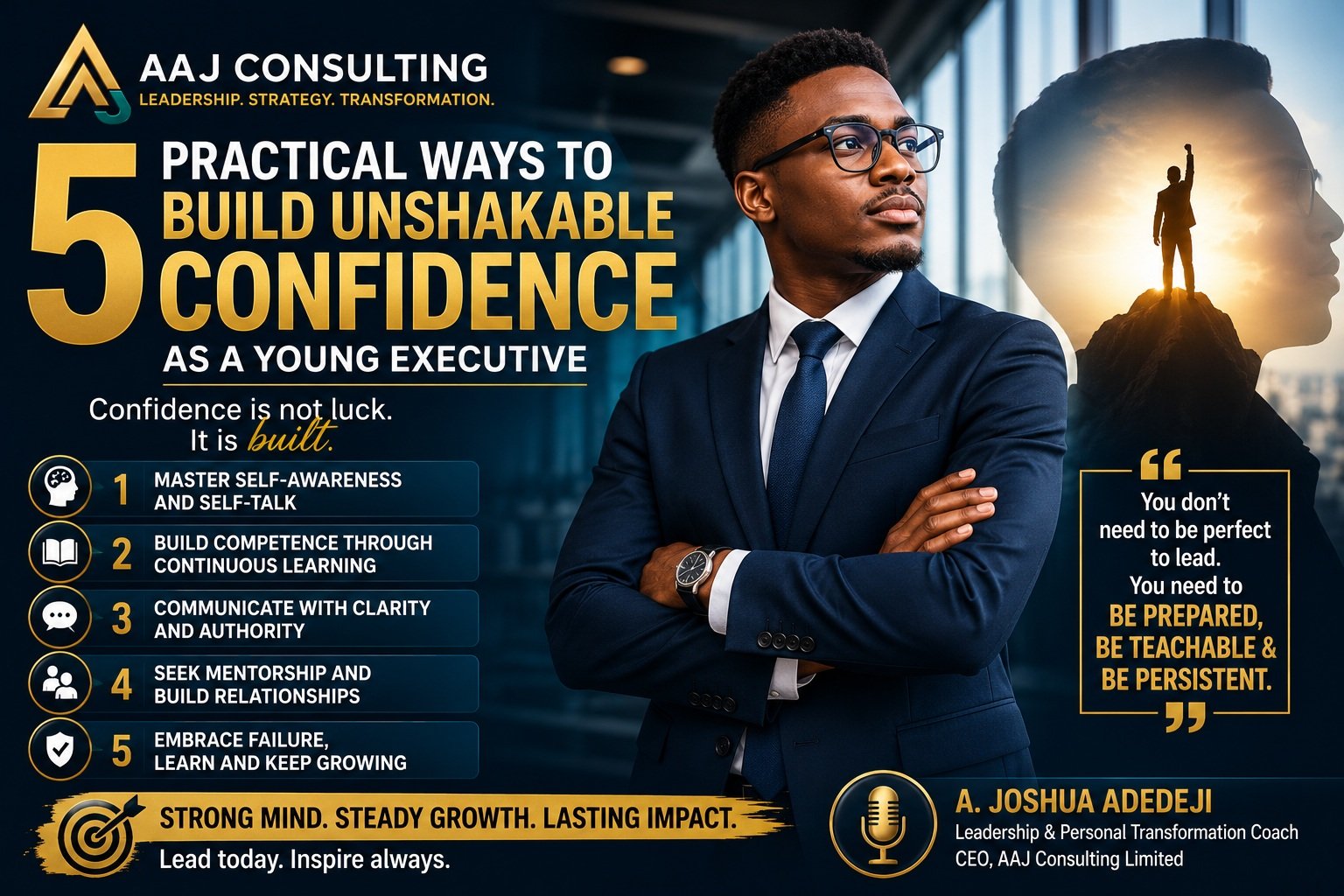
The Confidence Challenge for Young Executives
Stepping into an executive role young can feel like both a blessing and a test. On one hand, it shows people have noticed your competence and potential. On the other hand, it brings new pressure, visibility and responsibility.
Suddenly you are in meetings with people who have decades of experience. You make decisions that affect teams, budgets and partners. You may lead people older or more experienced than you, and inside you wonder if you truly belong.
For many young executives in Nigeria, Africa and beyond, there is a quiet battle — the battle for confidence.
You may know you are gifted, yet still ask, “Do I belong?” You may have results to show, but feel you must prove yourself each day. You may have good ideas but struggle to speak with authority. You may be called a leader yet wrestle with fear, comparison and imposter feelings.
You see, confidence is not arrogance. It is not noise. It is not pretending. True confidence is an inner steadiness that lets you show up prepared, speak clearly, take decisions with courage, learn from mistakes and lead without being driven by fear.
For the young executive, confidence is not optional. It shapes how you communicate, how you decide, how you build trust, and how people respond to you.
The good news is this: unshakable confidence can be built. It is not only for the naturally bold. It is grown through self-awareness, competence, communication, mentorship, resilience and steady practice.
Main Takeaways
- Unshakable confidence is developed through intentional practice, not luck.
- Young executives must manage inner dialogue, build competence, communicate clearly, seek mentorship and learn from failure.
- Confidence strengthens presence, improves decision-making and increases influence.
1. Master Self-Awareness and Self-Talk
The first battle for confidence is not in the boardroom. It is in your head.
Before others hear you, you have already heard your own inner voice. Before you present a strategy or make a decision, there is an internal conversation going on.
Often that inner voice is not helpful. It says things like:
“Am I really qualified for this role?”
“What if I make a mistake?”
“What if they find out I’m not as good as they think?”
“Why would they listen to me?”
“What if I fail?”
These thoughts seem small, but over time they sap your boldness and make you second-guess yourself. If you do not manage your self-talk, your self-talk will manage you.
Self-awareness helps you notice what is happening inside. It lets you see your thoughts, emotions, fears, strengths and triggers. A self-aware young executive pauses, reflects and responds — they do not merely react.
Confidence grows when you stop accepting every negative thought as truth. Ask yourself: Is this fear based on fact or assumption? Is my doubt from lack of preparation or from old insecurity? Am I incapable, or am I facing something new?
May I say, a young executive who learns to monitor and question their inner narrative becomes steadier, more teachable and more emotionally intelligent.
Practical ways to build self-awareness
Start by watching your thoughts before and after important meetings, presentations, negotiations or leadership conversations. Write down what you were thinking and feeling. Do this for a week or two, consistently.
Ask yourself: what situations make me feel least confident? Is it speaking before senior leaders? Giving feedback to older team members? Handling financial decisions? Defending my ideas? Leading under pressure?
When you know your confidence triggers, you can work on them intentionally.
Challenge negative thoughts with evidence. When your mind says, “I am not good enough,” ask, “What evidence proves this? What evidence contradicts this?” Often fear is louder than the facts. Then replace limiting thoughts with truthful, empowering statements.
Instead of “I don’t belong here,” try “I am growing into this role.”
Instead of “I must not make mistakes,” try “I will prepare well, act wisely, and learn as I grow.”
Instead of “Everyone knows more than me,” try “I can learn from others while still contributing value.”
Example
Imagine Chinelo, a 29-year-old executive in Lagos who led a project that missed its mark. After that, she began to doubt herself. Every meeting reminded her of the mistake. She became quieter, avoided bold decisions, and started seeing herself as a failure.
After journaling her thoughts, she realised the problem was not only the failed project but the story she was telling herself. She had turned one setback into a permanent identity.
She began to reframe the experience. Instead of “I failed,” she said, “I learned what does not work, and I am now better equipped to lead the next project.”
That shift changed her posture. She became more open, more prepared and more confident. Her team noticed the difference because her leadership became less defensive and more courageous.
Confidence begins when your inner voice stops fighting your future.
2. Build competence through continuous learning
Confidence without competence is empty noise. Competence without confidence may remain hidden. But when confidence and competence work together, a young executive becomes powerful, credible and influential.
One practical way to build confidence is to become genuinely good at what you do. Understand your industry, your role, your numbers, your people, your market and your organisation’s goals. You will not have to pretend. Your preparation will speak.
Competence gives weight to your voice.
Leadership is changing fast. Technology, artificial intelligence, digital work, remote teams, data analytics, customer behaviour and economic uncertainty are reshaping organisations. A young executive who wants to keep confidence must remain teachable.
In the Nigerian business environment this matters even more — changing regulations, infrastructure challenges, currency swings, talent gaps and fast-moving markets mean confidence cannot rest on title alone. It must be built on learning, adaptability and sound judgement.
You do not need to know everything, but you must be committed to learning what matters.
Practical ways to build competence
- Identify the most important skills for your role: financial literacy, strategic thinking, people management, data analysis, sales leadership, negotiation, public speaking, project management, digital knowledge, etc.
- Make a personal learning roadmap.
- Set quarterly learning goals. For example: one quarter focus on financial management; the next on executive communication; another on strategy, technology or leadership psychology.
Do not only take in information. Use it. Volunteer for projects. Ask to lead a presentation. Join cross-functional teams. Offer solutions. Try ideas. Review what happens.
You see, confidence grows faster when learning becomes practice. Many young executives keep studying but hide behind learning because they are waiting to feel “fully ready”. The point is: knowledge without action stalls growth.
Example
Consider Emeka, a young manager at a fintech startup in Lagos. He felt out of his depth when senior leaders talked about digital transformation, compliance and product strategy. Instead of pretending, he made a learning plan: one hour a day for industry reports, online courses and trends across Africa. Within months he asked better questions, his slides were sharper, and he could link local realities to global trends. Senior leaders started to listen. His confidence grew because he became more competent, not because he was louder.
3. Use Communication and Public Speaking Skills
You can have brilliant ideas and still lose influence if you cannot communicate them clearly. For young executives, the ability to speak with structure and conviction is one of the strongest confidence builders.
Every executive speaks publicly in one form or another: boardrooms, staff meetings, Zoom presentations, client pitches, even tough conversations with your team. A platform is not only a stage.
Communication is not about fancy words. It is about being clear, useful and persuasive.
Practical ways to improve
- Prepare. For important conversations know your main message, the outcome you want, the facts and your audience. Don’t enter important meetings casually.
- Use a simple structure. For example: the issue, the implication, the recommendation. The issue shows what is happening. The implication shows why it matters. The recommendation shows what should be done. This makes you sound clearer and more executive.
- Practice often. Join leadership groups, professional associations, Toastmasters, church leadership platforms, workplace presentations or community events.
- Record and review yourself. Notice pace, tone, posture, filler words, eye contact and clarity. It feels awkward at first, but it works fast.
- Ask for specific feedback. Don’t ask only “Was it good?” Ask: “Was my message clear?” “Did I sound confident?” “Where did I lose your attention?” “What can I improve?”
May I say: a confident executive does not merely talk. A confident executive connects. Communication confidence is built through repetition.
Esther, a young executive in Abuja, had plenty of good ideas but she rarely spoke up in meetings. She was afraid her voice would shake or that her points would not sound smart enough. So people often missed her contributions.
She decided to work on it. She joined a community leadership group and had to speak for a few minutes every week. At first she was nervous. Over time she got better. She learnt to organise her thoughts, keep eye contact and speak with calm.
A few months later she was asked to present at a regional business summit. The same woman who once avoided speaking had become a confident voice in her field.
Your confidence will rise when your voice becomes trained, clear, and useful.
4. Seek Mentorship and Build Strategic Networks
No young executive becomes truly confident in isolation.
You need people who will guide you, challenge you, encourage you, correct you and show you what you cannot yet see. Mentorship and strategic relationships build confidence because they give you access to wisdom beyond your own experience.
Many young people try to figure everything out alone. They think leadership means having all the answers. The point is: wise leaders learn from others.
A mentor helps you read seasons, avoid costly mistakes, handle office politics, manage pressure, negotiate better, build executive presence and make wiser choices.
In Nigeria, relationships matter a lot. Competence is important, yes, but relationships often create access, credibility and opportunity. That does not mean networking is about begging for favours or collecting business cards. Strategic networking is about building useful, value-driven relationships.
The right relationships strengthen your confidence because they remind you you are not alone.
Practical ways to build mentorship and networks
- Be clear about the growth you need. Is it career advice, leadership skills, industry insight, spiritual counsel, business strategy, emotional maturity or executive presence?
- Look for people who show the wisdom, values and results you respect.
- A mentor need not be famous. It could be a senior colleague, a former boss, a respected professional, a business leader, a pastor, a consultant or an experienced executive in your field.
- Approach mentorship with humility and clarity. Don’t just say, “Please mentor me.” Say, for example, “I admire how you lead teams and manage strategic decisions. May I occasionally ask you for guidance as I grow?”
- Give value. Share useful insights, support their work, respect their time and follow through on advice. Mentorship deepens when the mentor sees your seriousness.
- For networking, join professional associations, business communities, alumni groups, executive education programmes, industry events and credible online communities. Use LinkedIn intentionally — not just to post achievements, but to learn, engage and build professional visibility.
Example
Kunle, a young executive in Port Harcourt, felt stuck. He was smart and hardworking but lacked exposure. He started attending industry conferences and joined professional associations. At one event he met a senior executive who later became a mentor.
Through that relationship, Kunle learnt to think more strategically, handle executive conversations and position himself for higher opportunities. His mentor introduced him to people who widened his network.
As Kunle’s exposure grew, so did his confidence. He was no longer leading from a narrow view. He had access to wisdom, feedback and opportunity.
Confidence grows when you are surrounded by people who stretch your thinking and strengthen your courage.
5. Embrace Failures and Celebrate Wins
Every executive will face failure.
There will be projects that do not work. Presentations that do not land. Decisions that give unexpected results. Team members who disappoint you. Clients who reject your proposal. Leaders who criticise your approach. Strategies that fail despite your best effort.
If your confidence depends on everything going perfectly, it will always be fragile. You see, unshakable confidence is not the absence of failure. It is the ability to recover, learn, adjust, and keep moving.
Many young executives secretly fear failure because they think one mistake will expose them as incompetent. But failure is not always proof you are unqualified. Sometimes it is the price of growth. It teaches judgement, humility, patience, creativity and resilience.
The most respected leaders are not those who never fail. They are those who learn faster, recover stronger, and lead better after failure. At the same time, learn to celebrate your wins. Some young executives rush from one challenge to another without pausing to acknowledge what they have already overcome. That weakens confidence because the mind needs evidence of progress.
When you record your wins, you create a shelf of proof: “I have solved problems before. I have grown before. I have handled pressure before. I can do it again.”
Practical ways to build resilience
- After every major project, hold an after-action review. Ask three simple questions: What worked? What did not work? What must we do differently next time?
- Do not use review sessions to blame people. Use them to pull out lessons.
- Keep a success journal. Note completed projects, positive feedback, solved problems, courageous decisions, lessons learned and times you stepped out of your comfort zone.
- When you face setbacks, separate the event from your identity. A failed presentation does not make you a failed leader. A rejected proposal does not make you useless.
- Share lessons with your team when appropriate. Vulnerability, when spoken with wisdom, builds trust. Your team does not need you to pretend to be perfect. They need you to model courage, responsibility and growth.
Example
Ruth, a young executive in a multinational organisation, led a product launch that fell short of expectations. The criticism was public and painful. She could have withdrawn, blamed others, or avoided responsibility.
Instead, she led a transparent review. She acknowledged what went wrong, listened to feedback, documented lessons, and helped the team redesign the next phase. She also celebrated small improvements along the way.
Her response changed how people saw her. They respected her more, not because she never failed, but because she handled failure with maturity. That is executive confidence.
Practical examples: Nigerian and global perspectives
In our Nigerian situation, a young executive often leads in an uncertain environment — unstable power supply, inflation, shifting regulations, scarce resources, fierce competition, and cultural expectations around age and authority.
A 32-year-old in Lagos may lead a team where some members are older and more experienced. Confidence there will not come from a title alone. It will come from preparation, emotional intelligence, respect, competence and clear communication. Honour experience without surrendering authority. Listen well, set expectations clearly, and decide with fairness and courage.
In Abuja, a young executive working with government agencies, Non-Governmental Organisations, or development organisations needs confidence to engage stakeholders, present proposals, manage partnerships and defend strategic recommendations. That confidence must be built on research, clarity, professionalism and relationship management.
You see, a young manager in London, Toronto, Dubai or New York faces many of the same things we do here: imposter syndrome, workplace pressure, cultural mix, and high expectations. The basics don’t change — know yourself, build your skills, communicate plainly, find mentors and learn from failure.
Confidence looks different in each place, but its roots are the same.
Actionable steps for immediate results
Pick one thing you feel least confident about this week. It might be speaking in meetings, making decisions, networking, leading older team members, presenting reports or taking criticism.
Set one small weekly goal. For example:
- Speak at least once in every strategic meeting this week.
- Record and review one presentation.
- Contact one potential mentor.
- Finish one learning module.
- Write down your wins every evening.
Get an accountability partner — a colleague, mentor, coach or friend — who will check on your progress and nudge you to stay consistent.
At the end of the week, reflect. What did you do? What did you learn? Where did you get better? What still feels hard? What will you practise next?
Confidence grows when action is steady.
FAQs on building confidence as a young executive
Can confidence be learned, or is it just something you’re born with?
Confidence can be learned. Some people seem bold naturally, but real, lasting confidence comes from preparation, practice, feedback, self-awareness and experience. The more you act and learn, the more confident you become.
How do I get over the fear of making mistakes in a high-stakes role?
Prepare well, make informed choices and accept that growth involves mistakes. When they happen, don’t hide. Review them, take responsibility, learn the lesson and improve your process. Let mistakes teach you, not trap you.
What if I don’t have mentors in my sector?
Start with people around you: senior colleagues, alumni groups, professional associations, church or community leaders, consultants, online communities and LinkedIn contacts. Learn from books, interviews, podcasts and courses by leaders you respect.
How do I keep humility while staying confident?
Humility and confidence go together. Humility says, “I’m still learning.” Confidence says, “I have value to give.” A humble, confident leader admits gaps without feeling small and shares ideas without arrogance.
How do I lead people older or more experienced than me?
Lead with respect, clarity, competence and emotional intelligence. Don’t try to prove you’re better. Honour their experience, listen, set clear expectations and be fair. Consistent, sincere leadership wins respect over time.
Becoming an unshakable young executive
This isn’t a one-day thing. It’s a lifelong journey.
You grow confident as you know yourself. You grow confident as you get better at your work. You grow confident by communicating clearly, by building mentors and strategic relationships, and by facing failure and learning from it.
You don’t have to pretend to be perfect or to know everything. You don’t need to copy someone else’s style. Be willing to grow on purpose.
May I say: your age is not your limit. Your background does not disqualify you. Your past mistakes do not define you. Your present fears need not control your future.
You can become an executive who leads calmly, speaks clearly, decides bravely, learns humbly and influences with integrity.
Unshakable confidence isn’t made by waiting for fear to go. It’s made by doing the right things even while you’re still growing.
Next steps — a simple call to action
Choose one of the five strategies below and start practising it this week. Start small. Start now.
- Master your self-talk.
- Build your competence.
- Improve your communication.
- Reach out to a mentor.
- Review your failures and document your wins.
Don’t wait until you feel fully ready. Confidence grows as you move.
Your organisation needs young executives who are not merely ambitious, but prepared, grounded, courageous and resilient. May I say, your journey to becoming an unshakable young executive can begin today.

0 Comments
Join the conversation on “5 Practical Ways To Build Unshakable Confidence As A Young Executive”.